The Same Old New Story

On March 18 of this year of years, I joined a fledgling video story hour on Facebook.  Initially I joined because I’m a fan of the host, a musician who plays the violin most beautifully behind and around my guy JT.  Every day, at 5:00, I log on with a couple dozen other friends and fans to listen as our host reads from a wide variety of children’s classics, which has included Winnie the Pooh, Frog and Toad, and Dr. Suess favorites.  After a few children’s stories, we settle in for a chapter or two from a novel, enjoying not only the literature but also the life that our host brings to the pages with her voices for the various characters and moods. 

While our host reads, we listen and we exchange written comments in our chats about the book, all the while learning each other’s stories.  The stories our host reads to us are soul soothing, mind enriching, and heart warming and the stilling of our minds and bodies for an hour each day has been a most needed retreat for most of us.  “Storytime” has become, for me and I suspect for other members, as sacred as any other self-care ritual during this somewhat anxious time of social separation.  Most of us are devoted participants who try and attend daily and we’ve come to know each other in a special and memorable way.  Remarkably, our host has only missed a handful of times, showing up every day at the same time to read to us, to ask after us, to laugh and cry and wonder with us, and to wish us well at the end when she signs off with a kiss blown and a farewell of, “bye lovies, be well.”

A few days ago, a member of this little story club pointed out that it was our six-month anniversary and we celebrated by reviewing the many books our host had read to us.  I marveled at the time that had gone by and all that we had read and all that we had shared.  I also began to think about what these past months had looked like in our individual and collective lives. Having our frame of reference and our usual routines abruptly pulled away from us last spring, I was somewhat surprised to know that not only had Storytime been happening for six months, but also so had our days of quarantine and all that followed.  Although I knew rationally that time had not stopped or stood still, it certainly felt that it had been paused or at least been put into some sort of slow motion special effect that kept us from moving through life at our usual speed and intensity.

From the beginning of all things Covid in our country, I have felt somewhat contained inside a bubble of sorts, removed from real life and time by guidelines and restrictions and beliefs and even dirty looks from other scared and angry folks.  It has seemed to me that much of life hasn’t been real time but rather surreal time, with all of the separations and disconnects and uncertainties and cancellations and barriers. New ways of doing old things have felt temporary and false even though it’s likely that the new ways will be permanent and real. Like many, I have been waiting for a day when all can return to our feeling more sure and secure.  I have been waiting for my story to continue in a way that feels familiar and safe.

But as I continued to process what the past six months had held, I began to see that though the days are surely different now, they are actually much the same.  For as much as I’ve felt bubbled up and removed from reality, I’ve continued to live a life that includes and holds very real emotions, events, activities, and routines—some safe and familiar, some not so much but not all are unwelcome.  We may be living in a new version of real life, but it is indeed real, as it continues to reveal the good, the bad, and all that lies in between.  I’ve shared details of my life, parts of my story, with old friends and new friends and they have shared their stories with me, evidence that indeed life has not been standing still but rather, moving on in its way, taking all of us with it. 

While six feet of air space, a mask, and a Plexiglas divider may protect us from aerosol contaminants, there is no bubble that will shield us from the spread of life’s pleasure and pain.  We will continue to witness birth and death, we will receive both good news and bad, we will fall in and out of love, we will work and we will play, we will be ill and we will be well.  We will feel both hope and despair, joy and devastation, anger and forgiveness.   We will praise and complain, sleep and lie awake, and construct and destruct. We will succeed and we will fail.  We will live.  We will die.  Most and best of all, we will love. 

When Storytime celebrates its one-year anniversary in March of 2021, I hope to be more aware of the passing of time and to not be caught off guard by an amount of time that I disregarded as unreal.  I hope I will look back at six months gone by and realize that even though I couldn’t do it all, I absolutely had it all.  As for my newfound lovies at Storytime, I’m certain there will be celebration.  It could be that we will celebrate a reduced state of quarantine and separation.  It could be that we will celebrate a vaccine that protects us from further illness and death.  It could be that we celebrate a restored economy and returned freedoms for worship, entertainment, travel, and hugging—please let there be hugging!  Amid the uncertainties of what aspects of life may be worth celebrating in six months, of this I am certain: we will celebrate real life and friendship and love.  And our stories.

Blue Buttermilk

My official life career is over and done, in the rearview mirror.  I am a retiree, specifically, a retired middle school principal.  It’s funny how I began my career as a teacher, but retired from that trajectory as a principal.  I never wanted to be a principal but I always wanted to be a teacher.  Of course, it could be argued that good principals must first be good teachers but I’m not sure I could argue that good teachers make good principals.  Good teachers will always be good teachers.  Good principals have a lot to learn about issues and events that seemingly have nothing to do with teaching.  Good principals are expected to lead in many ways, with only a few of those ways being instructional.

I first became aware of my need to teach when I was about five or six.  I’d been to school and had become infatuated with the whole affair.  I loved my teachers, I loved the treasures in the classroom, and I loved the school day.  I was in awe of a place that I could go for a whole day to read and be read to, to play, to sing, to color, and to discover more and more about people and a world outside of my home and community.  To me, teaching and learning were pure bliss.

Years later, when I became a licensed professional teacher, I continued to feel that bliss.  I taught students with specific learning needs and I felt that I had a strong ability to task-analyze and teach skills in many content areas.  I still thought of school as an almost magical place where words and numbers and places came to life for students and teachers as they learned and grew together.

I’m not sure exactly why I made the decision to leave the classroom after fourteen years of teaching, but it’s possible I believed then that a good teacher would be a good administrator.  I initially served as a special education coordinator, working to ensure programming for students with special needs.  In a short amount of time, the bliss I felt as a teacher was replaced by sheer panic as I grappled every day with the enormity of the task.  That panic multiplied tenfold when after only a few years, I accepted the position of building principal and my experiences in the classroom slipped further and further behind me.

My role no longer depended largely on what I could teach; now, it was imperative that I continue to learn.  I had to learn about managing people, resources, and time.  I had to learn about budgets and funding.  I had to learn about conflict resolution and proactive communication  I had to learn how to appropriately celebrate the good but also how to take responsibility for the bad.  In short, I had to learn to be a leader and my years of classroom teaching had done little to prepare me for the complexities of leadership.

As a beginning principal, I sought out many learning opportunities to develop leadership skills.  At one particular weeklong training program, I was one of about 20 new school principals who, like me, wanted to strengthen their abilities to lead their school communities with confidence.  During one particular exercise, we were challenged to step up as leaders while bringing undesirable news and demands to our people.

Our training instructor arranged us in a circle and asked for two of us to volunteer for the exercise.   He asked for one volunteer who loved buttermilk and a few hands went up  He asked for another volunteer who disliked buttermilk and I was chosen from the many whose hands were raised.  The two of us—Buttermilk Advocate and Buttermilk Resister– were then told we had to convince others to drink the buttermilk.  The point of the exercise was to illustrate the relative ease of the Advocate in getting his people to drink the buttermilk in contrast to the job of the Resister, who didn’t like buttermilk but still had to convince others that they should drink it.  It was expected that the entire group would ultimately agree to taste the buttermilk.

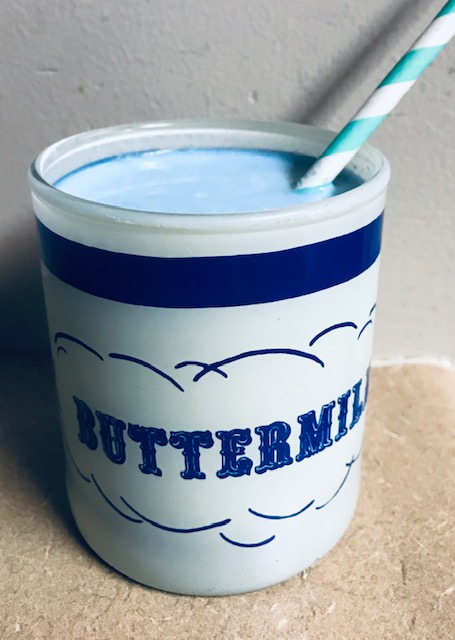
As the Resister, I remember muddling through somehow, maybe persuading a person or two to at least try the buttermilk and that even though I didn’t like it, I would go first.  In my naiveté, I may have even dared to tell them that if they didn’t like it, they would never have to do it again.  Once everyone had shared their intention to drink or not, the instructor gave us the actual buttermilk to distribute.  I was handed a clear plastic pitcher of buttermilk—or was it?—that had been dyed bright blue and was told to pour a taste for each of my people who agreed to drink it.

I panicked, much like I sometimes did at school.  My thoughts were racing and everyone was watching me.  I had promised them buttermilk and I had somehow convinced them that even though it was distasteful, I would lead them to a drink they could swallow!  No one said the buttermilk would be blue!  I didn’t even know if this was buttermilk!  I didn’t know if it was healthy to drink blue buttermilk!  I was no longer willing to drink it myself,  so how was I going to ask my people to drink it?

Unsure of my next step, I decided to just say the truth.  I admitted that I was unaware until that moment the buttermilk would be blue, but I felt we could work together to come up with a way to ingest it.  While we previously thought we knew what we’d be drinking, now we were unsure.  So, we could decide next steps together:  those who could identify the buttermilk would do so, then perhaps someone could develop other ways to taste it.  Members of the team suggested using the blue buttermilk in ways that would be easier to swallow:  blue buttermilk pancakes, muffins, and smoothies.  Others suggested that they could drink it anyway and perhaps stand in for someone who could not. Others were excited and intrigued enough to try it on the outside chance they might like it or learn something about it. One team member suggested that after drinking, the team should determine whether it was beneficial and how this situation or a similar one might be faced next time.

A set of behaviors began to emerge that taught me some important concepts in leadership:  be ready, ask questions, identify the problem, make a plan, execute, and then assess your plan for future planning and collaborate whenever possible so that the best people are where they are needed most.  However, I believe that the most important lesson learned was to be truthful with myself and others from the onset in order to work most strongly together.

I would revisit the blue buttermilk analogy many times over my twenty years in leadership.  I shared the exercise with staff and we laughed together but also knew that there would always be times when we would be served a big pitcher of blue buttermilk.  We knew, that for maximum efficacy, we would employ our abilities as a team to take it in, maybe even make it into something we could enjoy or profit from in some way.  We knew that sometimes I could ask, “how would you like your blue buttermilk served today?”  We also knew that on rare occasions, I would need to say, “Drink your blue buttermilk.”

As humans, for the past several weeks we have faced multiple servings of blue buttermilk.  Just when we think we can drink the regular buttermilk at the urging and support of our leaders, the buttermilk appears blue and there are more questions than answers.  Why the change?  Is this going to harm me or someone I love?  How much blue buttermilk can I drink and maintain my willingness to take one for the team?  Will we ever have regular buttermilk again?

Although I’m no longer in a formal position of leadership, I find myself once again in a position to learn more than I can teach.  I need to learn how to keep myself and my home healthy.  I need to learn how to stay connected to those I love.  I need to learn how to safely plan for my future.  I need to learn how to access reliable information for personal well-being.  And again, I need to learn to drink the blue buttermilk and ask others to do the same, even though I don’t want to.

I am a Resister and I’m raising my glass.  To our health.

Hindsight 20/20

Early this morning, despite having promised myself I’d practice some social media distancing to avoid the overload of sad and scary news and views, I opened an article posted by a friend because the title caught my eye.  “That Discomfort You’re Feeling is Grief,” by Scott Barinato, was posted on the Harvard Business Review site and at first glance, appeared to be organized into a friendly enough Q&A format. I tiptoed into the article much like entering a dark and creepy attic, with one eye closed and the other only partially open, as I was afraid of what I might find there. 

Before I reached the first creaky board, I hastily exited the article, because right before my eyes was confirmation of what I already knew: it’s just too scary.  After losing my husband Dan eighteen months ago and plunging into a level of grief I’d not known before, one that included isolation, fear, uncertainty, and sometimes hopelessness, I have only recently begun to see light again.  I have been getting comfortable with a new outlook and new feelings. I have gradually become able to honor my past life while I enjoy the present. Sometimes, I even dare to look ahead to the future. 

The arrival of a global pandemic (seriously, did we ever think we’d use these words??) has brought all of that to a halt, as I—and we—experience a loss not at all unlike the loss of a loved one.  We are experiencing grief and all its visible and invisible grips on our senses and sensibilities.  We are afraid and anxious and uncertain and untrusting and angry and sad as we slowly lose the lives we have lived and begin to glimpse the life we will need to live.  And it does indeed feel all too familiar.

Anyone, which basically means everyone, who has experienced grief knows perhaps the most paralyzing feature is fear and that the fear most often comes from the uncertainty. We are uncertain from the beginning this loss even occurred and we may spend hours, days, months or even years trying to convince ourselves that even if it did, we might have done something differently to change the outcome.  Even after we’ve accepted the loss to be certain, we face the additional personal and profound uncertainties of a life without our person, which touch every speck of our existence.  We are uncertain about every moment and decision making up our days, from the time we arise to the time we attempt to sleep.  And when the uncertainty is too much to bear, we just get sad.   And then mad.  And then maybe hopeless.   

We can use a lot of time and energy right now to question how the loss of our previous lives began.  Was it a guy eating a bat in China?  Was it because we didn’t act quickly and prudently?  We can also use resources and time to express anger when we think we know the answers.  We can lash out at leaders and we can rant to others about spring breakers and underground gatherers.  We can withdraw completely and hoard our food and necessities and hope for the best when we emerge.  We can, understandably, become so worried and sad that we lose sight of a bigger picture and we can begin to indulge in a version of self-care that is actually destructive.  We can overeat and drink alcohol to excess and use other mood-enhancers to temporarily numb our feelings, the whole time knowing when we wake up tomorrow we will face the same circumstances, only multiplied.

When this is all said and done (ish), how will we recall our responses and reactions and decisions?  Will we be relieved it’s over and move on quickly?  Will we be embarrassed or alienated because of any words or behavior that didn’t show us at our best?  Will we be newly energized and motivated to live a new life that includes skills learned during our distancing period?  What will we remember most?  How will we honor the life we led before the pandemic while grieving the life we lost? If hindsight is truly 20/20, then 2020 is the year to put those lenses on.  We can each take a look at lessons learned from previous losses as tools for dealing with our current loss.

I entered widowhood the same way I entered this crisis—unprepared and unwilling. I felt panicky and helpless and alienated by my former smart and resourceful self.  Now, though, when I look back, I can use lessons learned during that period to more clearly see the present and also the future with restored confidence and awareness.  I can recognize past emotions that will not serve me well and those that will.  Grief teaches us many things, but the most valuable lessons are those we learn about ourselves.  If we allow it, grief shows us we are strong when we need to be strong and it shows us when we need to rest and regroup.  It is equally important to master both of these. 

Looking back, I can see that even while grieving, when I needed to, I learned new skills.  I learned to manage on my own all the things I used to share with my husband—household minutia, bills, auto repairs, decisions.  Knowing I can learn during grief means I can continue to learn new things now.  Why, just this morning, I participated in my first videoconference and I didn’t do anything to embarrass myself or disrupt the meeting!

Looking back, I realize while grieving I missed out on moments and events and opportunities that took place during a time when my sadness and fear kept me homebound.  Now, I am required by the state to be homebound, but I know from looking back that I am okay at home.  I know how to constructively pass my time and when to allow for periods of acknowledging how I feel.  I know how to determine what is worth getting back and what is worth letting go of.  I learned from looking back there is indeed for everything a season and a time and a purpose.  

Looking back, I know my biggest hurdles during grieving were faced and conquered when I was taking the best care of myself.  I now accept and own the responsibility for my very being, physically, mentally, emotionally, and spiritually.  To that end, grief has taught me to eat, sleep, move, appreciate, create, learn, and most of all, to love and to keep loving. 

Looking back, I know, without a doubt, I would not have come through the period of uncertainty without the certain and undying love from friends and family.  So now, because I’m quite able, I try and give back over and over.  I stay connected regularly with family and friends.  I serve others when and however I can with new rules. When this is behind us and we look back, we will certainly know that how we connected with and cared for each other was and will always be vital to our survival. 

Looking back, I see maybe the most important new lesson I learned from grief was that I could experience both deep sadness and joy at the very same time and that was quite okay.  Although I miss my husband in all the spaces of my heart, those same spaces hold fierce love for our daughters and their husbands and their babies and my family and my friends and my life.  I have been overcome with sadness on birthdays and anniversaries and regular old nothing days without Dan.  I have also laughed at our memories and enjoyed trips and events without him and celebrated with great happiness as our new grandchild arrived.  I have realized by looking back that sadness and joy can coexist in a loving heart and this realization has allowed me to welcome new love and happiness, while again facing uncertain times. 

Now, when uncertainty threatens to escalate to fear and I’m feeling its familiar presence, I can see from where I’ve been that grief only comes from experiencing great love.  It is right for us to grieve now, as we face loss of life, loss of love, loss of freedoms, and loss of certainty.  But we have seen and may we continue to see that these losses will reveal happiness and joy to us if we let them.  If we can look back, we can look forward.  Hindsight is 2020.
A hallmark

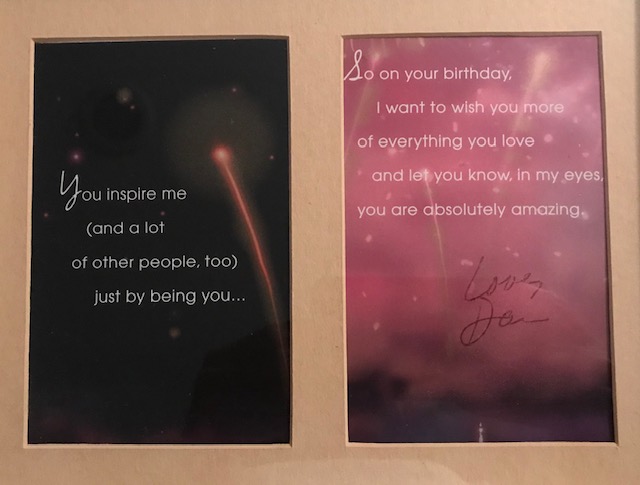
Years ago, on some 40-something birthday, Dan gave me this card.  Now, anyone who knew Dannoday knew that he was a most generous gifter, bestowing me with vibrant floral bouquets, blingy jewelry, decadent treats, first-rate show tickets, and when directed, an outfit or pair of great boots.  I grew accustomed to being called “spoiled” by friends and family, who knew that if a special occasion or sometimes even just a regular day was coming up, I’d be tearing through ribbons and wrapping paper to get to the good stuff.   What most don’t know is that he was also a most discerning and sentimental card-giver.  Unlike me, who would prefer to write my feelings rather than pore over a Hallmark selection looking for a version of those words, Dan would read each and every card in the designated occasion section until he found just the sentiment that matched his.  And so, when I opened and read this card all those years ago, I was moved more than ever before by his saying that I inspired him because since I’d known him, I surely felt it was the other way around. I also knew there could be no deeper expression of love than to celebrate the being of another human.

From the first time I met Dan O’Day, years before he became Dannoday, I was completely drawn to his brilliant mind, his ability to rapidly size up a situation to offer both opinions and conclusions, and his usually unbending certainty in decision-making and actions.  He read everything and I believed he knew everything—and if there were something he didn’t know, he’d find out immediately.  He had a quick wit, he made me laugh, and I loved him from the start.  He often told me in the beginning and again and again over the years that he felt the same way about me for the same reasons.  And so, when he proposed after only knowing me for 6 weeks, I said yes.  I had no doubts about our ability to build a life and I knew that he must be certain too; because that was the way he rolled. 

On September 13, 2018, Dannoday passed away from us, accepting a final certainty in much the same way he accepted all facts in his life.  He asked a few questions, determined what was to be, and then went about the rest.   What followed for me was a time of not only devastating and body-numbing grief, with all its known and unknown symptoms and nuances, but also a great selfishness.  Accustomed to mostly taking care of others, I was plunged into this deafening and relentless list of daily needs, new and intense personal needs, which ranged from physical self-care to emotional repair and maintenance.  Some days, by the time I was able to function in any way, the day would be done.  Tasks and activities that were once second nature for me took me hours and days to prepare for and to carry out. I went from being fiercely independent and credible and confident and strong to some shadowy and elusive version of myself.  The qualities I’d always been so sure of, the ones that Dan had loved so, were irregular and undependable and on top of everything else bearing on my heart and mind, I feared that in addition to losing Dan, I might also be losing my self.   

Then one morning I awoke thinking about the most peculiar thing.  I remembered a college philosophy course, a course that I hated because I needed more certainty than it could offer, which included the proverbial discussion of George Berkeley’s question: If a tree falls in the forest and no one hears it, does it make a sound?  I hated that question when I was 19.  I thought it was not worthy of any discussion and certainly not worthy of the attention of scholars.  With all of the trees in the forest, did it really matter if one made a sound when it fell?  Who really cared? Who would ever know?  But all these years later, on this particular morning, I got it.  I felt as if I were the falling tree and the only person who could hear me, who would ever be able to hear me, was gone.  I was terrified.  What if Dannoday never heard me again? Would it matter ever again what I thought, what I felt, what I knew, what I did?  Would he ever feel as proud of me as he did when he picked the perfect Hallmark card for my birthday?  As I said, this has been a most selfish trip and I was bound and gagged by the fear and wonder of a life without Dannoday. My fear wasn’t about not having a man, a partner, a mate.  It was about not having my PERSON.  Dan was the one who provided me with constant feedback and validation, whether it be frivolous and silly, critical and thought-provoking, spoken or unspoken, solicited or simply offered up.  Now, without him, that validation was gone.   And so, on that morning, I knew with certainty, the certainty that I thought was lost to me that it does indeed matter if a tree makes a sound.  It’s simply about validation: acceptance, affirmation, acknowledgement, honor, and love from the one who is meant to hear it.  

As we reach The Date, the one I have both dreaded and wished for, I am relieved to find the selfishness has subsided somewhat and that I can now sometimes see beyond today and even think a bit about tomorrow.  I still practice great self-care and I continue to gratefully accept (and return) love, care, and validation from my cherished family and friends.  With time and a whole lot of good/bad/ugly moments, I have come to know that Dannoday will always hear me and see me and validate me and that I’m still standing, that this tree hasn’t fallen completely. The love we shared and the life we built is empowering me to feel affirmed every time I remember a past moment, appreciate a current moment, or contemplate a future moment.  I see and feel Dan’s hands in the minds and hearts of our girls and their guys and in our beautiful baby grands.  And so, to honor this date, I’m sending a self-written thank-you card to Dannoday, which would make him roll his eyes and shake his head.  The man hated thank you cards, only slightly more than he hated a reveal party but much less than he hated a misplaced apostrophe.  In my card, I would simply tell Dannoday “thank you.” Thank you for giving me the very best gift of our lifetime.  Thank you for being the one who was meant to hear me. Thank you for being the one to show me how much a life could matter.